
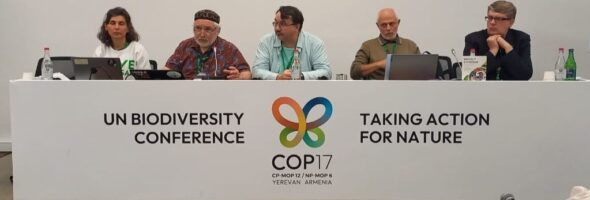
On 27 October, civil society organisations from across Northern Eurasia met in the Blue Zone for side event #7184, “Nature Without Borders: Civil Society and the Future of 30×30 in Northern Eurasia”. Co-organised by BIOM (Kyrgyzstan), Rivers without Boundaries and ACBK (Kazakhstan), IUCN Central Asia, EcoLur (Armenia) and the Save Siberia and Far East Foundation (Russia), it asked one question: how can Target 3 become real protection on the ground rather than a “paper 30%”?
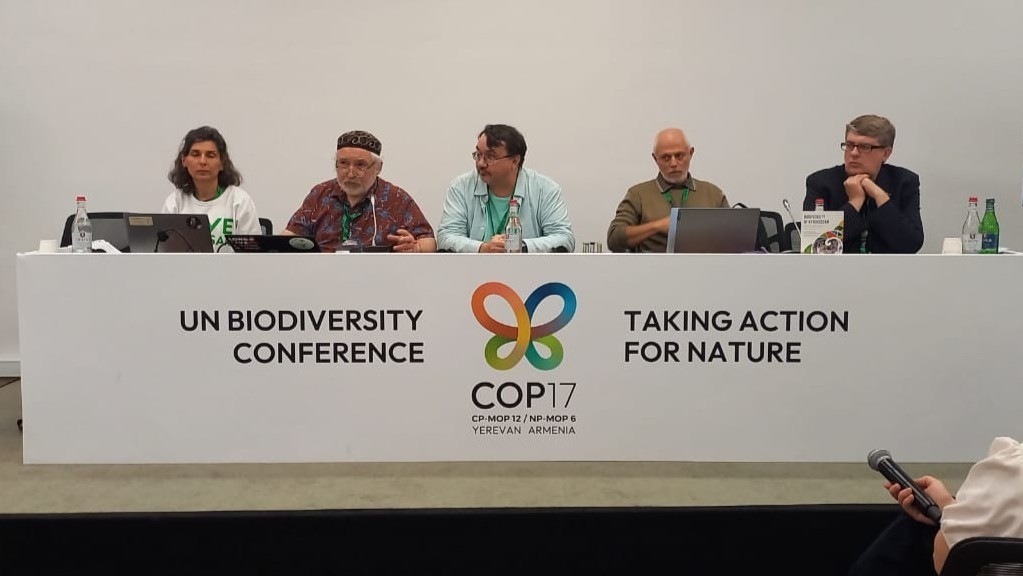
Moderator Alexander Kolotov (Rivers without Boundaries) recalled the region’s zapovednik legacy — strict reserves created by scientists and defended by student nature-protection brigades — and its fragility: in 1951, 88 reserves were abolished at once. Today the threat comes from many private actors seeking resources, including inside protected areas. October consultations with 50 participants from seven countries concluded that in Northern Eurasia, 30×30 is not only about new hectares but also about defending existing protected areas that are themselves under pressure. Reporting and indicators work only under civil society pressure, so NGOs proposed four tools: independent Target 3 monitoring modelled on World Heritage monitoring, reality checks of national reports, no-go areas for finance, and transboundary connectivity.
Vladimir Korotenko (BIOM) showed how Kyrgyzstan’s new State Biodiversity Programme aims for a single functional natural system covering at least 30% of the country by 2040 — starting from 6.5% under formal protection. An ecological framework built from twelve data layers maps candidate areas, from OECMs and micro-reserves to Pamir-Alai corridors, and the SCO’s 2026–2031 Action Plan opens the door to a regional ecological network. Yet plans to build or rebuild half of the national roads cut across priority areas.
Arpine Galfayan (Armenian Environmental Front) contrasted two European cases. In June 2026 Montenegro proposed a Natura 2000 network covering over 44% of its territory. Armenia, meanwhile, is moving to cut its candidate Emerald sites by 31.5% under an EU-funded, World Bank-implemented project: the Sevan site would shrink from 489,000 to 156,000 hectares, and Amulsar mountain — site of a contested cyanide heap-leach gold mine — would be excluded entirely, along with key Lesser Kestrel habitat. NGOs were not consulted.
Ilya Smelansky (ACBK) reminded delegates that 2026 is the International Year of Rangelands and Pastoralists. Temperate grasslands remain among the least protected biomes: only about 4% of Kazakhstan’s steppes and dwarf-shrub deserts are protected, and new threats now come dressed in green — mass tree planting and wind farms on intact steppe. He called for rangeland OECMs, mapping of relatively intact grasslands, and better coherence between the Rio conventions.
Eugene Simonov (Rivers without Boundaries) turned to rivers, which hectare-based targets and KBAs routinely miss. In Kazakhstan’s Ili basin the number of hydropower dams doubled in 2010–2025 and is planned to double again by 2040; Russia is reviving Soviet-era mega-dams such as the 11 GW Evenkiiskaya project; Mongolian plans threaten World Heritage and Ramsar sites. Rivers without Boundaries offered to coordinate a joint CSO report on freshwater conservation needs in Northern Eurasia.
The closing discussion focused on a lasting regional civil society platform. In a pre-event survey of 50 registrants, nobody opted out of further cooperation and 12 volunteered for a working group.
Beyond the room
Forty-five people followed the livestream, and the questions kept coming — after the session closed, Eugene Simonov continued answering them online until the next broadcast began. This shows how many stakeholders and NGOs remain unable to take part in COPs in person. Rivers without Boundaries will host a dedicated webinar with COP17 participants to share outcomes and answer questions from everyone who could not come to Yerevan.