

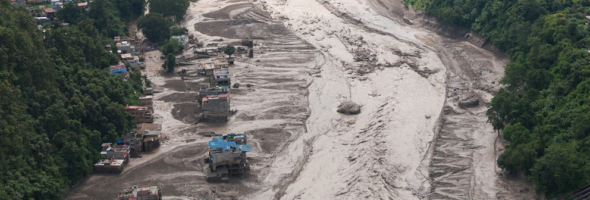
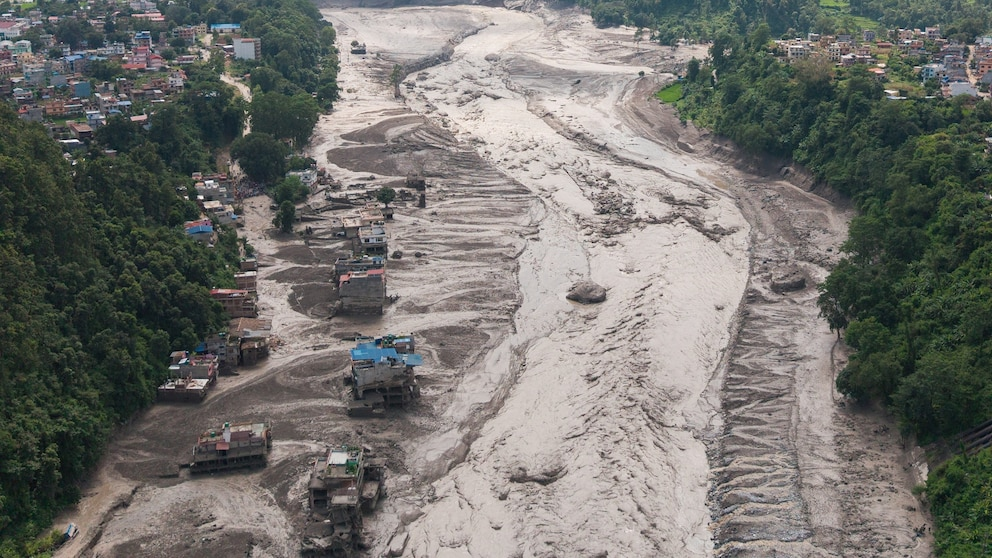
In late August 2026, the mountains of central Nepal roared, and a geological time bomb finally detonated. Following the collapse of a glacier near the Tibetan border, a catastrophic wall of water, mud, and debris tore through the Bote Koshi and Trishuli river valleys. For the communities and workers caught in its path, it was an apocalyptic event.
At least 750 people were killed, and over 3,000 remain missing. The torrential floodwaters effectively erased entire riverside settlements, including Trishuli Bazaar, and laid waste to the region’s heavily industrialized energy infrastructure, affecting hydropower plants and numerous transmission lines and substations. At the epicenter of this devastation was the 216-megawatt Upper Trishuli-1 (UT-1) hydropower project. Once touted by international financiers as a triumph of “green” infrastructure, the $650 million facility was practically obliterated, with 90% of its above-ground facilities and base camps destroyed.
The human suffering is staggering. Korean engineers from Doosan Enerbility and Korea South-East Power (KOEN) vanished in the mud alongside hundreds of Nepali laborers who had been working deep inside the tunnels. As of August 30, the UT-1 Project alone was still missing 140 workers not found dead or alive. Yet, in a display of profound, almost dystopian callousness, the UT-1 project management posted a notice for 137 new job vacancies just two days after the disaster—while rescue teams were still frantically digging through the rubble for their buried colleagues.
This tone-deaf move encapsulates a broader, systemic disease within Nepal’s hydropower sector: an industry blinded by technocratic hubris and driven by a relentless pursuit of profit, entirely detached from the ecological and human realities of the Himalayas.
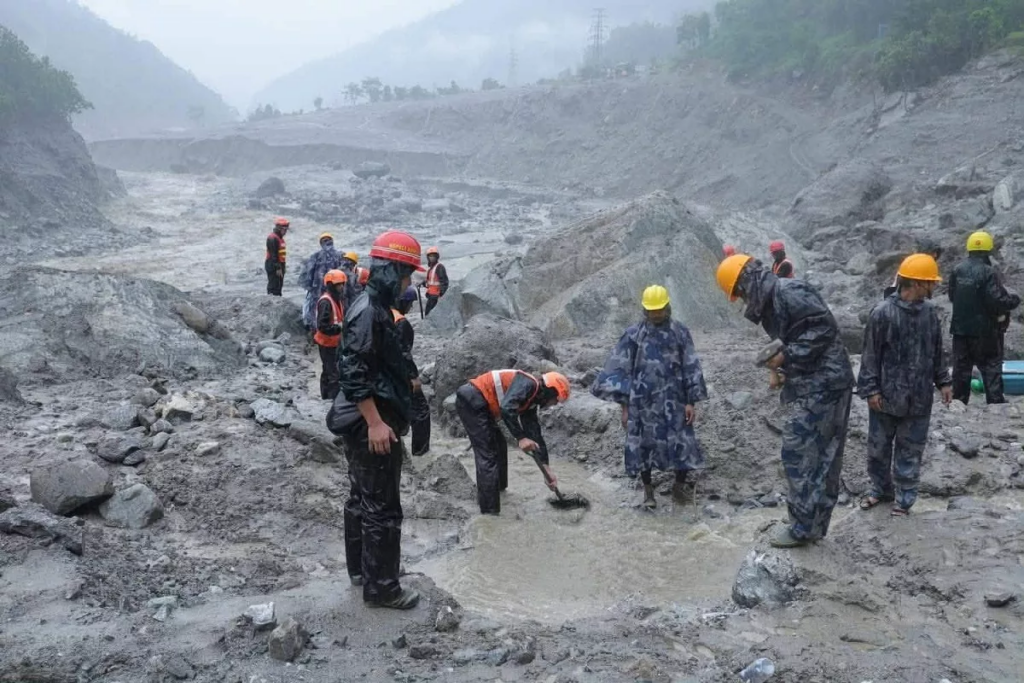
Image: Rescue operations near Trishuli 3a Hydro. Source: Ratopati.
A Disaster Foretold: The Ignored Warnings of 2015
To geologists, climate scientists, and environmental activists, the August 2026 flood was not an unpredictable “freak” disaster. It was a tragedy years in the making. The Himalayas are the youngest and most restless mountain range on Earth, characterized by extreme seismic activity and fragile geology. Add to this the rapid, climate-induced melting of glaciers—which creates precarious, swollen glacial lakes—and you have the perfect recipe for Glacial Lake Outburst Floods (GLOFs).
Warnings have been sounding like alarm bells for over a decade. Following the devastating 2015 earthquake, experts explicitly cautioned against the frenzied construction of dams in these volatile river basins. The 2015 quake had already triggered massive landslides along the UT-1 project’s access roads, sweeping vast tracts of land into the river and causing extensive fatalities among the indigenous population.
Environmental scientists and media outlets, such as The Ecologist in 2015, warned that building massive hydropower stations and dams in fault zones was akin to planting a “hydro-bomb.” They painted a nightmare scenario: an inland “Fukushima moment” where an earthquake or glacial collapse would unleash a massive tsunami of water and rubble, taking out scores of downstream villages.
Despite these glaring red flags, the warnings were systematically suppressed. Driven by a hegemonic political discourse that framed unbridled hydropower expansion as the singular engine for Nepal’s prosperity—the dream of becoming the “battery of South Asia”—domestic elites and international financial institutions (IFIs) pushed blindly forward. Planners at UT-1 and other projects willfully neglected basin-wide hydrological realities. They limited their environmental risk assessments to the immediate construction footprints, treating climate change, cascading floods, and transboundary geological hazards as mere externalities.
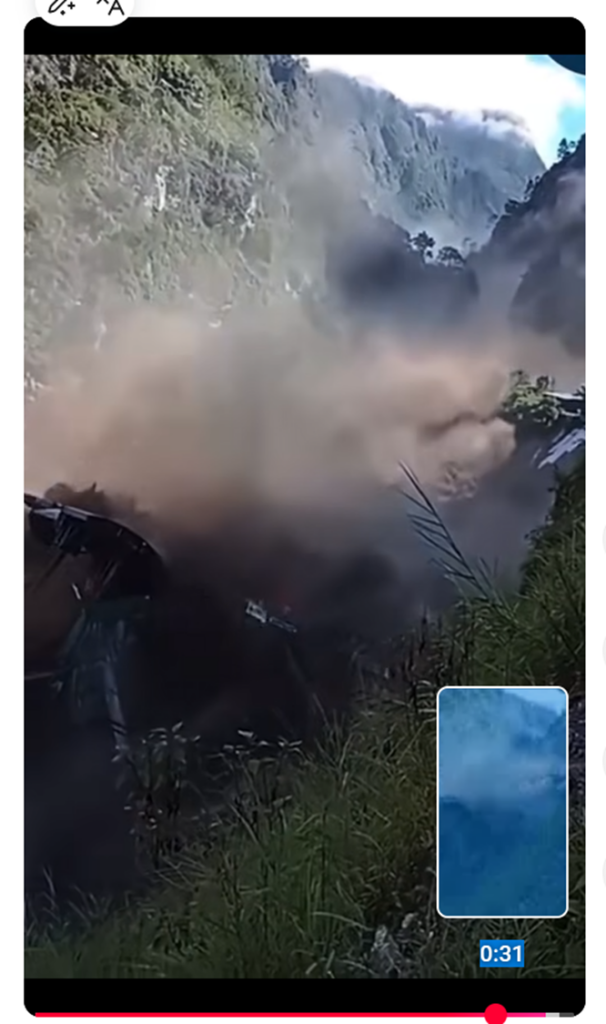
Video: Flood wave coming to Upper Trishuli Dam.
Human Rights Trampled in the Rush for Power
The environmental negligence that led to the destruction of UT-1 was matched only by the trampling of human rights. Long before the floods wiped away the physical infrastructure, the project had already erased the cultural and economic foundations of the local indigenous Tamang communities, who constituted 90% of population affected y that megaproject.
The UT-1 project confiscated significant community forest land and severed river access vital for traditional livelihoods. Villagers lost access to the stretches of the Trishuli River used for drinking water, irrigation, fishing, and traditional cremation rites.
To secure international funding from institutions like the International Finance Corporation (IFC) and 11 other finance institutions, in 2019 developers claimed to have achieved Free, Prior, and Informed Consent (FPIC) from the indigenous population. However, independent assessments revealed this to be a bureaucratic farce. The FPIC process was hastily documented years after actual land expropriation had occurred. It bypassed traditional self-governing institutions, excluded numerous impacted settlements, and offered meager cash compensation that fractured social ties. The “green” label slapped onto UT-1 was entirely performative, masking a brutal reality of ecological degradation and indigenous marginalization.
A Grim Future: The Case for Radical Diversification
The August 2026 floods have delivered a devastating, undeniable verdict on Nepal’s current energy strategy. In a single stroke, the disaster knocked out at least 15 hydropower projects, wiping out hundreds of megawatts of capacity—roughly 10% to 20% of the country’s installed generation. The economic losses run into the billions of dollars, and the psychological trauma inflicted on the riverine communities is immeasurable.
Nepal’s grand ambition to rely solely on massive, export-oriented hydropower to fuel its economy is officially drowning. Jumbo export plans, requiring tens of billions of dollars in foreign investment, are built on the fundamentally flawed premise that Himalayan rivers are stable, predictable resources. As the climate warms and the glaciers melt, these rivers have become volatile corridors of destruction.
The future of Nepal’s electricity sector looks incredibly grim if it continues down this path. The time for incremental policy tweaks has passed; the country urgently needs a radical reorientation of its energy sector. The relentless, speculative licensing of undammed rivers must cease immediately. Jumbo, capital-intensive megadams earmarked for export to India and Bangladesh must be canceled before they become the next ground zero for a climate catastrophe.
Instead, Nepal must urgently diversify its renewable energy portfolio. True sustainability demands a rapid pivot toward decentralized, low-impact energy sources like solar and wind power. These technologies can meet domestic energy needs without fragmenting vital ecosystems, displacing indigenous communities, or carrying the existential threat of inland tsunamis.
By clinging to a hydro-monopoly, Nepal is not securing its economic future; it is playing Russian roulette with its mountains, its rivers, and its people. The roaring, mud-choked waters of the Trishuli River have spoken. It is time we finally listen, before the next “Fukushima in the Himalayas” washes away what little is left.
Beyond hydropower, the entire paradigm of living along mountainous rivers should be reassessed. When restoring livelihoods of local communities priority should be given to re-establishing settlements well above the line hit by the 2026 flood.
Our hearts are with Tamang indigenous communities and all other residents of the Trishuli River valley, which will never be the same place…