

Rivers without Boundaries (RwB) participated in the 48th Session of the World Heritage Committee, held in Busan, Republic of Korea, from July 19 to July 29.
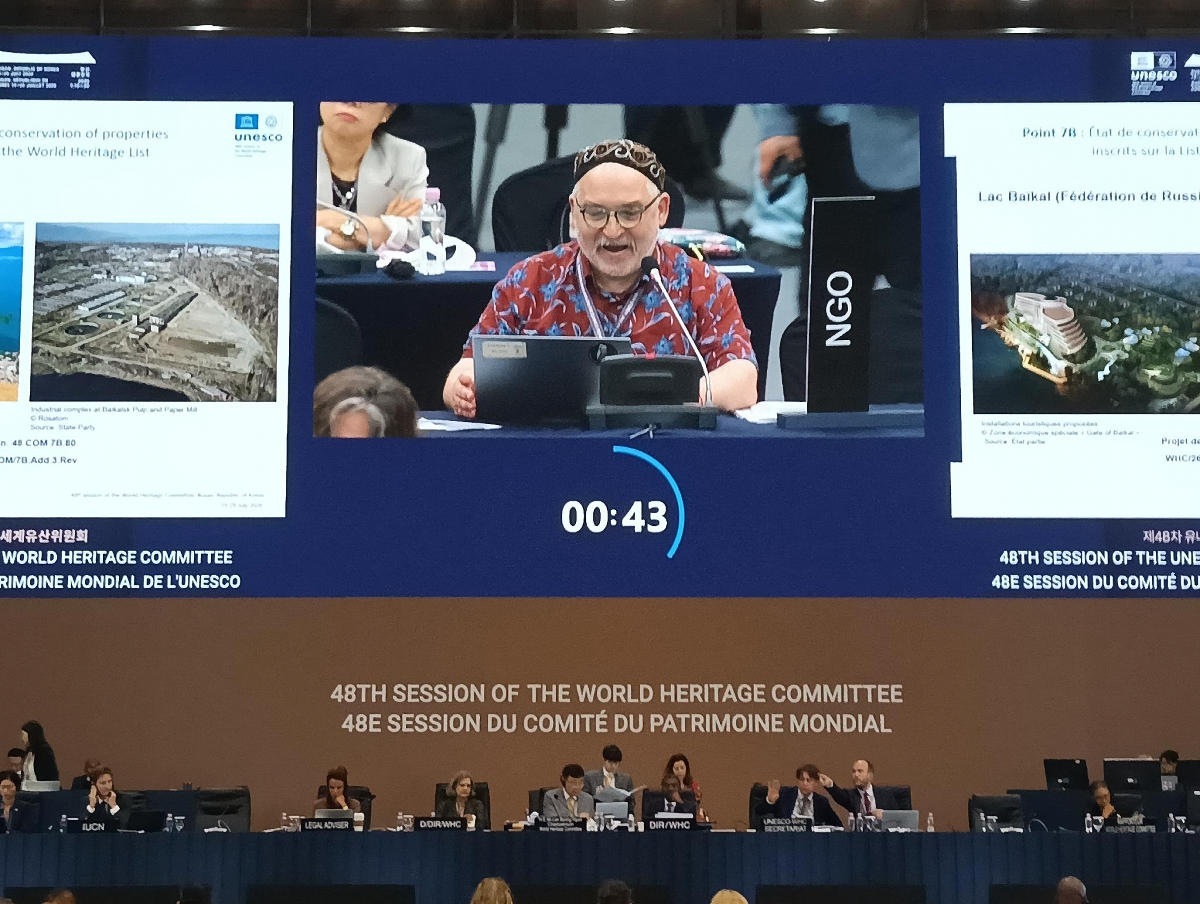
Unfortunately, the working environment for civil society participation within the Committee process has continued to deteriorate. Similar to last year, during the first day’s procedural item on “admitting observers,” a Committee member successfully lobbied to expel two NGOs present at the venue, primarily due to their country of origin (Russia). This escalated a dangerous precedent set the previous year, when an NGO that was not even physically present was symbolically expelled at a Committee member’s request. This growing pattern of weaponizing the Convention’s vague rules—allowing the Committee to expel organizations deemed undesirable by a single member state—undermines UNESCO’s cooperation with NGOs. Meanwhile, the UNESCO bureaucracy has proven entirely toothless and unable to confront this threat.
In the twelve months leading up to the Committee meeting, RwB submitted at least ten monitoring updates on World Heritage properties, including the Curonian Spit, Volcanoes of Kamchatka, and Sikhote-Alin, as well as reports on broader attempts to weaken protected areas legislation in the Russian Federation. RwB also published its observations in the 2026 World Heritage Watch Report.
Decisions regarding the three aforementioned properties were prepared by the World Heritage Centre and approved without discussion. These decisions emphasize the need to assess the potential impacts of various large-scale projects that could negatively affect the sites’ heritage values. For the Volcanoes of Kamchatka, the decision calls for incorporating the Zhirovaya and Vilyuchinskaya Bay areas into a newly established national park. These areas have been left unprotected since 2020, as they were targeted for cruise tourism development under the “Park Three Volcanoes” megaproject. If Russia fails to reinstate these protections by February 2026, the Committee recommends adding the property to the List of World Heritage in Danger.
Unlike other Russian World Heritage properties, Lake Baikal was proposed by the World Heritage Centre for inclusion on the List of World Heritage in Danger, and the draft decision was opened for discussion. The primary rationale for this proposed inscription was the Russian State Duma’s adoption of amendments to the “Law on the Protection of Lake Baikal,” which permit land clearing for construction, clear-cut logging, and other development along the lakeshore. Despite the Committee’s repeated warnings to Russia against passing these amendments without thorough consultation with the Convention’s bodies, they were adopted in December 2025, prompting the “in Danger” recommendation.
However, Kazakhstan, a Committee member, argued that because a joint UNESCO/IUCN Reactive Monitoring Mission is scheduled to visit Lake Baikal in August 2026, any further decisions should be deferred to 2027 and based on that mission’s forthcoming report. The matter was put to a vote, and Kazakhstan’s proposal was adopted by a majority.
During the session, RwB heavily focused on critical Lake Baikal issues that were omitted from UNESCO’s State of Conservation report. Through individual discussions with Committee members and a formal oral intervention at the Session, RwB reminded attendees that for a full decade (since 2013), the Committee had expressed deep concern regarding the potential cumulative impacts of several large water infrastructure projects planned in the Lake Baikal basin in Mongolia (including the Shuren Hydropower Plant, the Orkhon water diversion complex, and the Egiin-Gol Hydropower Plant).
Previously, the Committee had repeatedly requested that Mongolia submit Environmental Impact Assessments (EIAs) for each project in the Selenge River basin, along with a Cumulative Impact Assessment (CIA) evaluating their combined threat to Lake Baikal’s Outstanding Universal Value (OUV). Mongolia was also urged to prepare a joint Strategic Environmental Assessment (SEA) with Russia to explore alternatives to the further fragmentation of the river system.
In January 2024, Mongolia informed UNESCO that it had abandoned the Shuren and Orkhon projects, leaving only the Egiin-Gol dam in active planning. Consequently, the Committee concluded that assessing the cumulative impacts of multiple dams was no longer necessary and dropped its requests for both the CIA and SEA.
However, over the past two years, the Mongolian government has quietly reintroduced the Orkhon River water complex into its short-term Action Program, labeling it a key “megaproject” of national importance. Furthermore, since 2025, Mongolia’s Nationally Determined Contributions (NDCs) and National Adaptation Plan to Climate Change have explicitly included plans for the construction of both the Orkhon-Gobi Water Complex and the Shuren Hydropower Plant on the Selenge River, alongside other smaller reservoirs in the Lake Baikal basin. Notably, some members of the Mongolian delegation admitted to RwB representatives that they were completely unaware these parallel projects had been reactivated.
RwB argued that the re-emergence of these multiple dam projects necessitates an urgent reiteration of the Committee’s previous requirements for impact assessments. Specifically, reinstating the CIA and SEA mandates within the World Heritage context is crucial to preventing irreversible damage to Lake Baikal. RwB expressed strong hope that the upcoming Reactive Monitoring Mission will conduct an in-depth investigation into this recurring threat, and that the eventual 2027 Decision will reinstate impact assessment requirements identical to those originally established by the Committee in 2016.
Eugene Simonov,
DoC, International Coordinator, Rivers without Boundaries