


Over the past decade, energy officials and climate activists have grown accustomed to celebrating the rapid decrease in solar and wind power generation costs. However, in 2025, it was energy storage, not renewable generation, that provided a cause for celebration. Hydropower now faces pressure from the development of other storage technologies.
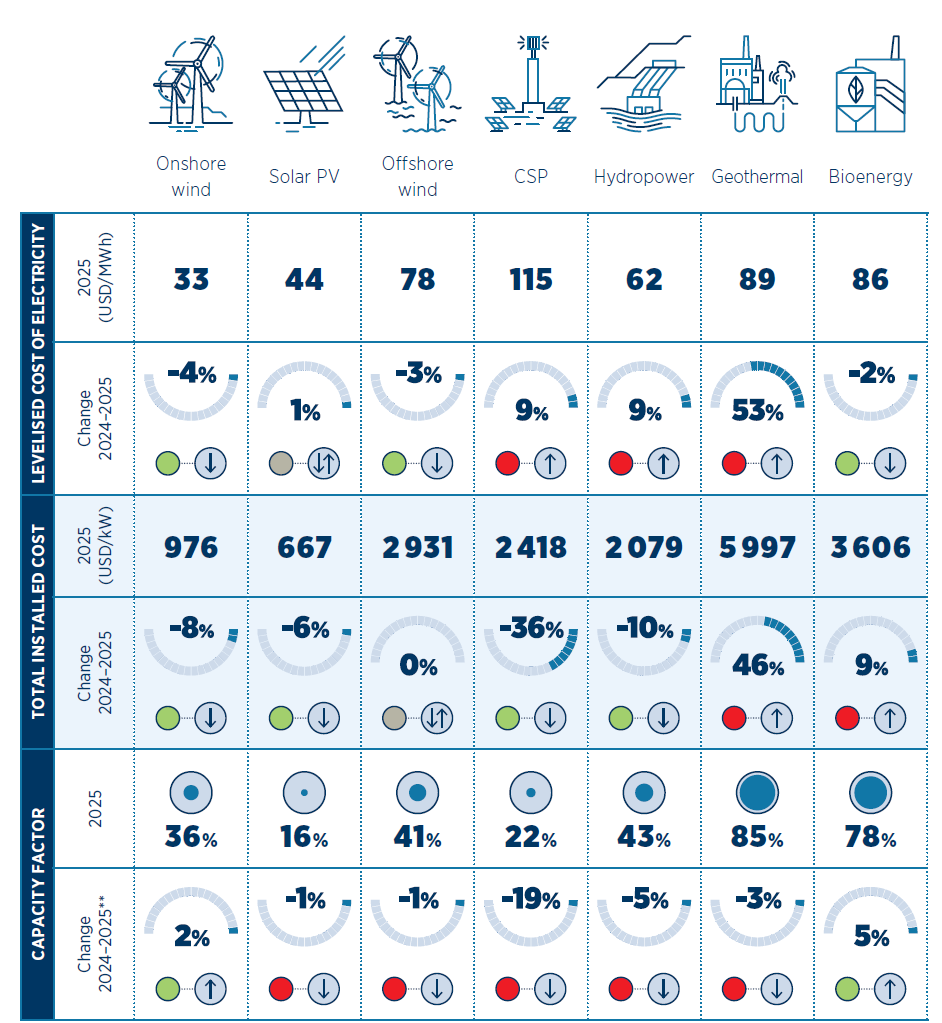
According to Renewable Power Generation Costs in 2025, a report released by the International Renewable Energy Agency (IRENA), renewable power costs have stabilized after more than a decade of steep declines. Solar PV remained at its 2024 level of USD 44/MWh in 2025, while onshore and offshore wind costs fell 3-4%, to USD 33/MWh and USD 78/MWh, respectively. In contrast, most dispatchable renewable technologies recorded higher costs again, with hydropower, geothermal, and concentrating solar power rising to USD 62/MWh, USD 89/MWh, and USD 115/MWh, respectively.
Hydropower Costs Climb Amid Complex Conditions
In 2025, conventional hydropower demonstrated a sharp increase in new installations, ranging from 14 to 18 GW according to different agency estimates. This figure is roughly twice that of 2024 and is driven by completion of megadams in China, Ethiopia, Bhutan, and India, which together make up 70% of the global capacity increase. The prevalence of super-large dams, which benefit from economies of scale, led to a 10% decrease in construction costs, down to USD 2,076 per kW. However, conventional hydropower represented only 2.5% of all renewable energy (RE) capacity installed in 2025, while solar accounted for 70%.
Regionally, countries of the former USSR are lagging somewhat behind in this process. In 2025 Kyrgyzstan led the region in hydropower additions with a mere 0.11 GW. Meanwhile, the absolute champion in renewables—Uzbekistan—added more than 1.1 GW of wind and 2.7 GW of solar, but only 0.045 GW of hydropower.
The reasons why the decrease in construction costs was associated with a 9% increase in the actual cost of energy produced by new hydropower facilities are complex. On the one hand, IRENA notes that unfavorable hydrological conditions (partly caused by climate change) and higher financing costs offset the decline in capital expenditures, raising the cost of electricity produced. On the other hand, a 5% decrease in capacity factor may suggest not only a lower availability of water flows through turbines, but also the deliberate use of power plants by operators to produce peaking power and other system services at the expense of maximizing overall power production.
The Surge of Pumped Storage Hydro (PSH)
Although hydropower is two to three times more expensive and time-consuming to build than variable renewables, it is now being praised by international agencies and the industry itself for its “increasing strategic role” as a provider of flexibility, storage, and system services. It allegedly enables the rollout of more wind and solar capacity without the risk of disruptions to regional energy systems. This statement has its merits, and the rapid development of pumped storage hydro is the clearest manifestation of its accuracy.
In 2025, pumped storage hydro (PSH) added more than 11 GW globally, marking the greatest annual addition of this technology ever achieved. PSH is the most mature and widespread type of long-duration energy storage (LDES). It pumps water uphill when energy is cheap (typically at night) and provides for peaking demand by letting the water flow downstream through turbines. PSH does not produce additional energy but rather redistributes the energy supply over time. The global project pipeline for PSH now exceeds that for conventional hydropower, clearly showing a change in priorities.
Looking at the former USSR, only Russia has some 1.3 GW of PSH built near Moscow, while Uzbekistan and Kazakhstan have announced intentions to develop PSH capacities in the near future.
Apart from PSH, a variety of LDES technologies are emerging, including chemical, electrochemical, thermal, and mechanical types. These alternative LDES types reached a record level of deployment in 2025, with new capacity of 2.0 GW/9.6 GWh—97% of which was in China—bringing the total capacity to 5.1 GW/25.6 GWh. Additionally, the project pipeline contains approximately 97 GW/422 GWh across 26 countries. Currently, two technologies dominate deployment: flow batteries (43% of the total) and compressed air energy storage (38%). While most LDES remains more expensive than lithium-ion battery storage, compressed air and thermal storage are already cheaper for durations beyond eight hours in those markets outside China, where lithium-ion is more costly.
Compressed-air energy storage (CAES) is currently the most cost-competitive long-duration option. A survey by the LDES Council estimates construction costs for intraday CAES systems (100 MW, ten-hour design) in 2025 to be between USD 160 and 470/kWh, falling to between USD 120 and 445/kWh by 2030. For comparison, PSH installation costs currently start at USD 153/kWh.
The Unstoppable Rise of Battery Storage
In 2025, short-term battery storage (BESS) recorded the largest cost decline of any utility-scale technology. Fully installed costs for utility-scale systems fell around 30%, reaching USD 140/kWh. This figure was roughly 95% below the 2010 level. Global deployment reached 108–112 GW, a 40–48% year-on-year increase.
For BESS projects with a discharge duration of around four hours, applications vary by market:
- South Africa: Deployments focus on improving grid resilience and reducing peak demand.
- Chile: Projects enable renewable energy integration and load shifting.
- Germany: Installations are mainly used for frequency regulation.
BESS projects with discharge durations of two to three hours support a wider range of use cases, including backup power, capacity replacement, and integrating renewable energy resources.
The added BESS capacity for energy shifting in 2025 was nearly 83 GW/241 GWh, which was 63% higher than the capacity added in 2024. This accounted for nearly 74% of the total new BESS capacity added in 2025. In many countries, combining BESS with solar and wind projects is mandatory, making them a source of flexible generation at a lower cost than developing hydropower or fossil fuel generation facilities.
Neither long- nor short-term battery storage has yet become an established technology in the countries of the former USSR. Recently, Uzbekistan has shown interest in developing a large-scale BESS facility, while some agencies in Kazakhstan are promoting the addition of BESS to newly built wind and solar farms.
Implications for Conventional Hydropower
For greenfield projects in conventional hydropower, the rapid development of storage means its comparative value as a short-term source of flexibility may rapidly diminish. Combining BESS with variable renewables is scalable, less expensive, faster to build, and more resilient to climate change. A similar trend may soon challenge the competitiveness of PSH technology as other LDES options reach maturity and reduce their construction costs.
By Eugene Simonov